
Have you ever felt like the clutter in your home is also cluttering your mind?
Transform Your Life and Achieve Happiness with These Five Simple Steps Today!
What if I told you that mastering the art of organization could unlock a happier, more productive life? Yes, it's possible! And today, we're going to unravel the secrets together to make it happen.
So, let’s find a way to tidy your living space – and stay on top of it!
Hi my, Lovelies! Today I’m going to dive into the world of organization.
I know, I know, it doesn’t sound that exciting, but once you discover the magic behind this… is going to be a game-changer.
You know, clutter isn't just about physical stuff—it messes with your head too. All those piles of things we hang onto can drag us down, zap our energy, and keep us stuck in the past.
But when we learn to let go of what no longer serves us, we make room for new opportunities, fresh perspectives, and a whole lot of positive vibes.
In my seminars, coaching sessions, and everyday encounters, I meet plenty of people, and the happiest ones are often those who seem to have things together.
It's no coincidence. When you declutter your life, inside and out, you shed those weights that hold you back. And that's exactly what we'll learn to do today.
Let’s talk about creating an environment of the things you enjoy or actually truly need.
1. Identify “clutteraholics” and how to avoid becoming one
Do you realize how much stuff people gather in their homes and storage units? According to a National Geographic study, 1 in 40 people in the US is a hoarder.
I've seen this firsthand when I organized a garage sale to sell my parents' house items—it was unbelievable to hear how many people admitted they didn't actually need anything.
Can you believe it? Some hadn't even unpacked all the boxes from their last move 20 years ago!
When I asked why they didn't just donate those sealed boxes to the nearest charity, I only got blank stares! Some even looked uncomfortable!
But if they hadn't used or needed the contents in 20 years, why were they holding onto those things? It doesn't make sense.
Yet, they couldn't resist buying more items from our sale and usually left with a couple of laundry baskets filled with more stuff to clutter their homes.
For me, it was fine because I needed to clear out an entire house quickly and nothing ended up in the trash.
But it's really sad to think that these buyers were just adding more items to their piles at home when nobody really needed them in the first place.
More stuff in their homes means less space to live.
If you don't want your house to become uninhabitable, you'll need to start with the basics: get rid of anything you can let go of.
2. Clear your clutter
I get that this can be a bit hard to grasp, but don't worry, there's a great book I often refer to called "Clear Your Clutter with Feng Shui" by Karen Kingston.
Honestly, I don't know much about Feng Shui, but you don't need to in order to benefit from this book.
It's really helped me over the years to stay organized and let go of unnecessary stuff, both at home and in my businesses.
It makes regular cleanups and getting rid of things we don't need super easy.
Because, let's face it, we don't need to hold onto everything.
Like Karen says, if you move and end up with more than two trash bags full of stuff, that's clutter! And she's right, isn't she?
If you didn't need it in your old place, why keep it now?
The truth is, we don't have to keep every little thing we buy or receive as a gift. Not every book we've read, you know?
Get rid of damaged, bent or half-broken items as well. Treat yourself with respect, and you deserve to surround yourself with items which are in good order.
For example, I do not keep plates or mugs that have a chipped edge. I can let them go and make room for wholesome dishes to come my way.
When I was younger, I used to be impressed by houses with bookshelves everywhere.
But then I realized that many of those were just showing off, trying to seem important with all those books.
They often lacked warmth and the ability to communicate, and were weighed down by holding onto so much.
In the end, all those pages became mere dust collectors with stagnant energy.
With this book from Karen Kingston, I learned that regular cleanouts help refresh the mind and soul, keeping us from becoming grumpy old folks.
So, your task today is to go through every item—books, DVDs, collections—and think about why you have them. How often do you actually use them? Are they still useful?
Could you store all that information in a format that takes up less physical space—like on a Kindle or tablet? Or maybe you could downsize and keep only the best?
My rule is, if I haven't opened a book or collection in over five months, then it doesn't serve much purpose in my life now.
So, I don't dwell on it anymore; I thank them for their role at the time and free my home from thoughts and memories I no longer need daily.
By letting them go, you make room for positive thoughts and new, exciting memories.
Now, I'm not saying you should go full-on minimalist—definitely not.
I have a dear Irish friend who's a world traveller, and everything she owns fits in an 18 kg backpack. It works great for her, but I wouldn't want to be that extreme, ha ha!
I like to surround myself with things that inspire me. But I'm careful not to let them take over my life and become a burden.
Now that you have several bags or boxes of things you no longer need, what's the next step?
3. Try and sell it or give it away – don’t hold on for too long
There are a few ways to part with your things: sell them or give them away.
Selling is usually the best option if you want to make some money, and it's often the first choice.
If items are in good condition and you no longer use them, it's better to find them a new home and earn a little cash in the process.
But don't be one of those who holds onto items for months because they're asking for too much money.
You know what I mean? Or worse, you end up arguing with buyers online or in person. That's not cool, right?
It's better to set a deadline to clear out those things from your space.
Otherwise, I guarantee those boxes of clothes and kitchen gadgets will still be there one or two years later, gathering dust and stagnant energy.
And if selling isn't an option or seems too complicated, you can always choose to give things away. Whether to friends or family who can use them.
And if you have no one to give these things to, that's okay too. You can donate them to someone who really needs them.
There are plenty of organizations and shelters that accept donations of clothes, furniture, household items, and even toys for children. It's a great way to give back and make a difference.
The box technique
Now, I understand that some things are easier to part with than others. For this, I use a trick I learned from Karen Kingston for when you're not mentally ready to let go of certain things right away.
She suggests packing them into a box, storing it in the closet or basement, and leaving it there for a pre-selected period.
I usually schedule a "review the box" reminder on my calendar exactly 3 months after the date I packed it. This helps me stay focused.
Then, 3 months later, I stand in front of the box and try to remember what's inside. If I recall something and realize I truly need it, I take it out and keep it.
Often, I had already taken it out during those 3 months.
If I don't remember anything from the box, it goes straight to the donation center. Trust me, once you start doing this regularly, it gets easier each time.
Just last week, I cleaned out my office and have an old suitcase, a moving box, and three white plastic bags ready for donation.
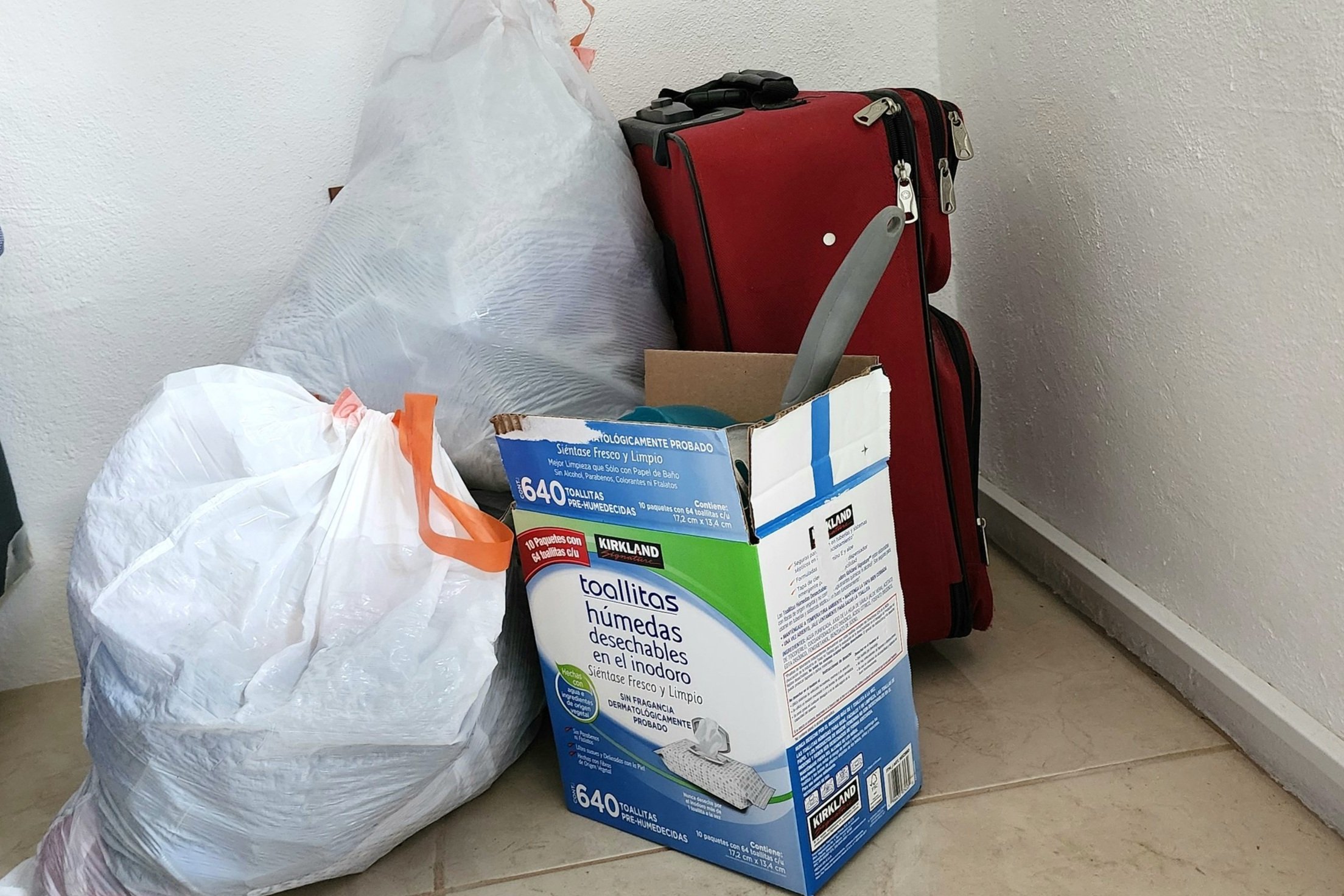
Donations are ready to be dropped off
Doing the yearly clear-out of my office yielded to two black garbage bags for the curb and as seen in this picture: three white kitchen garbage bags, a little red suitcase and a cardboard box to go to the local charity shop.
4. How to create a child memorabilia box
But for those things that are really, really hard to let go of, simply keep them, you don't have to let them go. Look, I've moved several times across continents and countries.
What I always bring along is a large plastic container with a lid to protect against dust and moisture.
In there, I keep my cherished childhood memories: drawings I made, some stuffed animals, handwritten letters, greeting cards, my collection of Smurfs, crafts, a few things from my deceased brother, baby shoes, my first ballet leotard, first print editions and CD backups of my first published book in 2008, and other treasured items.
At least once a year, I carefully unpack the box, enjoy the contents for an afternoon, and then pack it all back into my office closet.
For me, this is the perfect selection of memories in a box that I find very acceptable.
5. Make a photo album to cherish loved ones from your past
Another great idea is to create your own photo album of items and memories. Yes, it's a bit unconventional, but hear me out.
When my brother passed away and I had to clear out his apartment, I didn't want to keep many physical items because I didn't have space or a purpose for them.
Instead, I took his negatives, slides, and also some special objects for him and our family. I photographed those items and then gave them away.
For example, my brother had several vinyl records. He introduced me to great bands like Marillion, Pink Floyd, Rainbow, Eurythmics, Kate Bush, Kiss, AC/DC, Queen, Gary Moore, David Bowie, Dire Straits, and more in the '80s.
Those records meant something to me because my brother had great taste. However, moving them abroad with me wasn't practical, and I don't even have a turntable!
But I included them in the photo album I made about my brother's life by taking pictures of my favorite album covers and dedicating a double-page spread to them. And the records?
They found a new home with a collector who had a basement full of them and was thrilled to have them. It was the perfect solution!
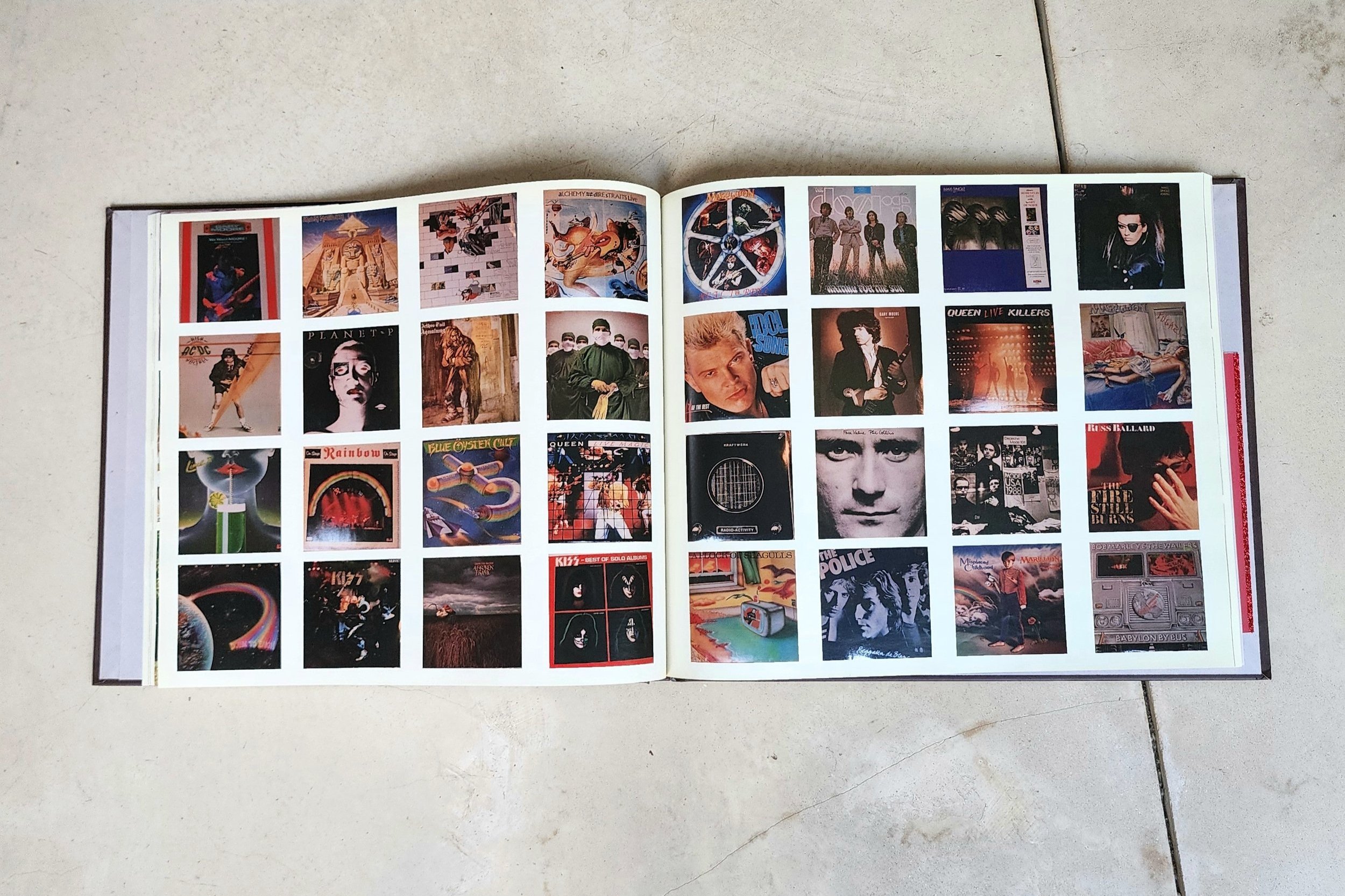
Record Covers
32 records on one double page - that’s what I call reducing clutter and preserving memories of your loved ones.
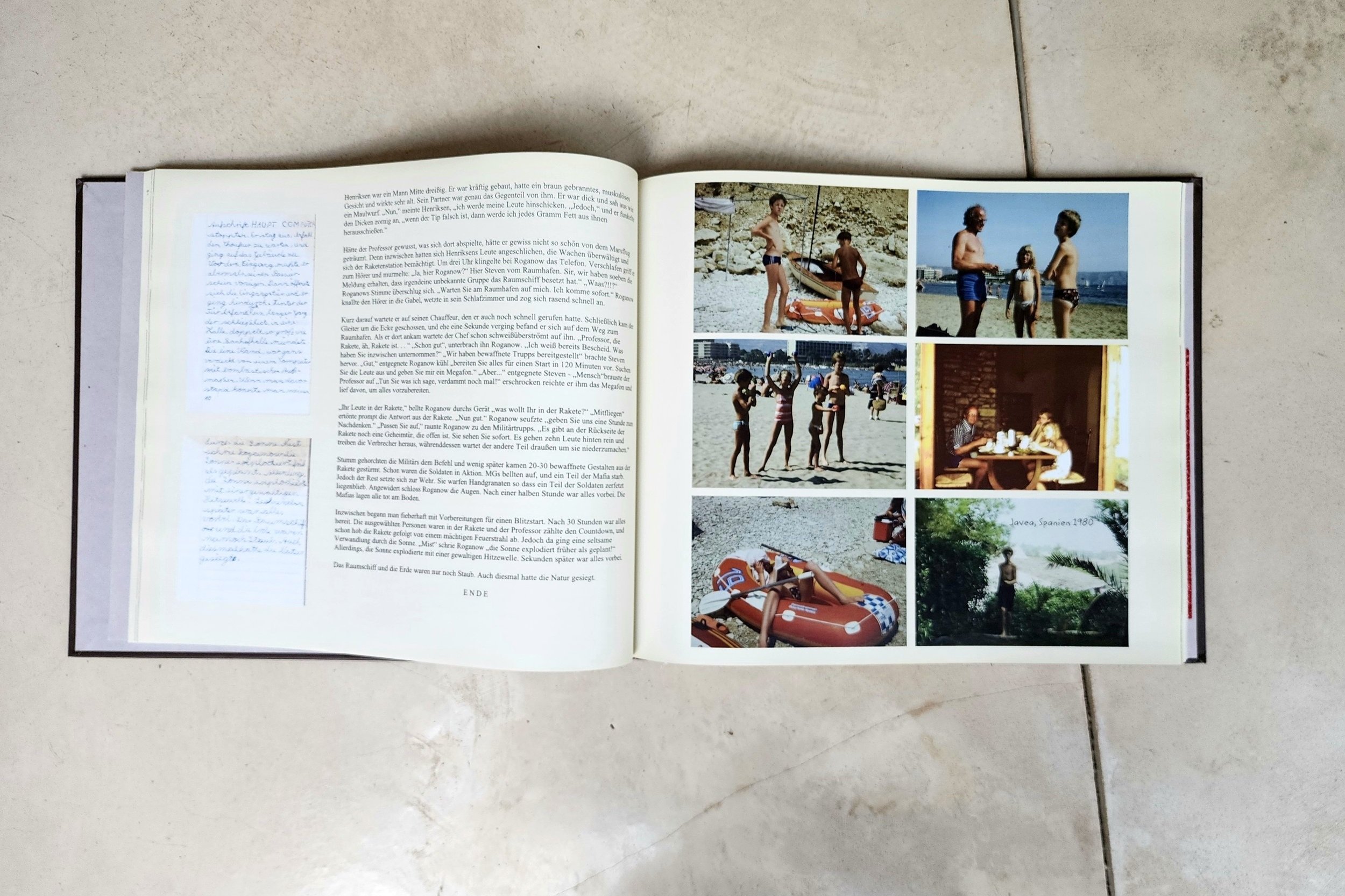
Scan or take photos of original postcards or written treasures
Include original texts or handwriting and lots of photos to cherish happy times.
In the same way, I took photos or scanned some of his writings, like a story he wrote in 7th grade. By printing those pages in the album, I managed to reduce the physical items I felt I needed to keep.
My brother's entire life, everything important, was captured in 200 pages and over 2,000 photos. And that's easy to carry to the next move.
Below, I've included links to my favorite photo album printers in case you want to check them out. There are so many good options available nowadays.
It's easy to download the software, choose templates, or create your own from scratch.
Make sure to wait for discount codes or subscribe to receive them by email; they can make a big difference if you're ordering several books.
But remember, be thoughtful: only buy what you need, not items that will sit in a box waiting to be opened for months.
So, what do you say, my Friends? Are you ready to embark on this decluttering journey with me? I created a fabulous free pdf Worksheet for you to download on our website, see link below.
Reduce, clear out and grow!
Thanks Lovelies, it was nice to have you here today and I’ll see you in my next blog . Hugs from June Jones Joy.

Meet Merlin, our latest adoptee
He keeps us on our toes to put our socks away, as Merlin has the reputation of “stealing” them off the floor and take them to bed with him. Haaaa.